Here is an account of the cataclysmic tsunami that struck Maldives on 26th December 2004. It was written and published by me on my then digital playground at maldivianunderground.net. I had kept the page updated for a few days as the events unrolled. It is in its original form and was last updated at 15:53, 31st December 2004.
-----
PRELUDE
The earthquake that originated in Sumatra, Indonesia, on the 26th of December 2004 resulted measured in tsunamis that inflicted massive destruction in the Maldives. The earthquake a whopping 8.5 on the Richter scale at its origin and was felt at a thankfully lower 4.0 in the Maldives (according the Meteorological Department). The following is an account of the events that took place with a major viewpoint from the authors location, Male’.
THE EVENTS
Beginning…
The earthquake was felt in the Maldives at around 6.25am, the morning of 26th Decemeber '04, right when most of the country was about to wake up. The government working hours begin in the Maldives at 7.30am. The shakes were mostly minor, though people in different islands have been reporting of having felt tremors of varied intensities. There has been no reported news of the earthquake directly inflicting any damages. Life went on as normal for most people till around 9.20am, when massive waves shocked everyone.
In Male’
Male', the capital of Maldives was among the first islands to be hit by the waves. There was no news, no warning that such an event may take place. Sea faring vessels were all docked at the harbors and jetties. People were enjoying another sunny day by the beachside while some were swimming in the lagoons. Assembling together the eyewitness accounts of the invasion by the waves indicate that at first the sea levels dropped abnormally low. While this may have acted as a warning sign of an imminent tsunami for some, most people in Maldives have never ever heard of a tsunami before, let alone have seen or experienced one. Oblivious to what was happening, everyone kept to their affairs till the oceans rose sharply. The sea bubbled up from afar, nearer to the beginning of the reef as a giant wave started to mount up.
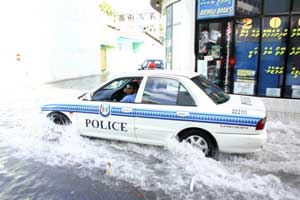
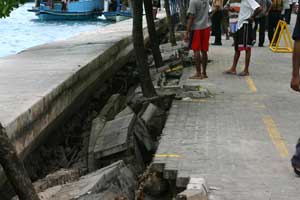
Witnesses claim having seen waves larger than 7 meters in height. The waves gained momentum, building up higher and higher till it reached the sea wall around Male’. (The sea wall was built by the Japanese government, as a means to protect the then rapidly eroding and constantly-under-wave-threat Male’.) Witnesses say that the wall successfully thwarted most of the force from the waves. However, the waves climbed over the sea walls and crashed into the outer rim of Male’. This is where most damage is seen now. The waves damaged a lot of the boats in the harbor and sank a few. Several were lifted up and brought over onto the land as well. The Eastern and Southern sides of Male’ experienced the waves most. Sand, coral and other debris was brought onto the land. The waves crossed the outer road, smashing onto cars and motorcycles parked in the area. Cars were carried with the waves and crashed into shops and food outlets in the South-Eastern side of Male’. Tin roofing, used as partitioning, were seen to have been bent and deformed as the force of the waves drove into them. Living quarters located in the southern side, sheltering some expatriate workers were damaged as the iron rods and sheets construction buckled under the waves and deformed. No deaths were reported in the capital Male’ although around 40 were reported to have suffered injuries, mostly minor.
Islands
The events unfolded more terrifyingly for most islands. The islands, numbered at 1190, that Maldives is composed stand at an average of 1 meters above sea level. Islands lack a sea wall and have no wave protection other than that provided by the reef. The massive waves crashed into the islands and crossed from one side to the other uprooting trees and shrubs located in the beach area. Few boats were dragged into the land as well. The loose sands of the islands were washed away leaving behind eroded beaches. Fishes were seen swimming in the flooded streets. Several houses, often shoddy and not built as strongly as that in the capital, collapsed in the islands.
Resorts
The sequence of events for the resort islands were pretty much the same as the islands. Since a lot of resorts have water bungalows, the bungalows were hit by the waves first. Waves are reported to have smashed into the sides of the bungalows, breaking windows, flooding the interior dragging and floating the furniture inside. Jetties leading up to the bungalows took serious blows as well and several have been reported to have taken serious damage. The waves washed over the smaller resort islands uprooting trees and shrubs and bringing in debris. Fishes, including baby sharks were dragged into the islands. Some resorts experienced electricity problems due to floods in their power generation plants.
Aftermath
Relief operations in Male’ began work in the latter part of the day. The public were on the scene first protecting their homes from flooding waters. The police began work pumping out the waters flooding the streets of Male’. Police were also at work along with public removing the debris littering the roads of Male’. Work to lift up boats that sank into the harbor was carried out as well work to place the beached boats back in water.
In the islands, death reports are mounting up and mostly include the elder and the younger. Causes of death vary and are mostly vague at the moment. Lots were reported to be injured although hard figures are not available as of now. This vague description of the events in the islands will be complemented with more details as we get hold of it. Several islands have been evacuated and residents moved to nearby islands. Residents in some islands have also been gathered into large community areas such as school halls to help account for all aid supply operations. Most islands have total destruction with no building left intact. Beds, mattresses, clothes, utensils, electronics gear and monetary savings have been either swept away or destroyed by the waves. Islands are reported to be uninhabitable anytime in the near future. There is hardly a place to shelter all the people in need.
Missing persons were reported across the resorts as lots of tourists were in the sea swimming and snorkeling when the waves hit. One death, having caused by heart stopping due to shock has been reported. Tourists are being relocated to safer areas and some have been moved to other islands.
Damage assessment was delayed since communications was unavailable to most parts of the country. The government established a taskforce to assess damages and oversee the relief operations. An operation to send in supplies to the islands was started around 8pm. The work is being carried out by volunteers and is based at Aminiyya School. The public and businesses located in Male’ contributed food and clothes to be sent to the islands. Medicine is not included in this supply operation at the moment. All areas are reportedly having problems obtaining clean drinking water. The taskforce is calling out for more volunteers to help pack the supplies and is also calling out for boat owners to help deliver supplies to the areas in need.
FOLLOW UPS
The account above was written 5am 27th December. However, we intend on posting updates and photos over the coming days as relief operations continue.
Feel free to contribute photos and videos to us and share any news you may have on the day’s events and the relief operations. Send any pictures or videos or even accounts of your experience to [email protected].
We call out for all Maldivians to join in full community and national spirit to help Maldives recover from this unfortunate event. We also urge international agencies to help us in this time national disaster and aid us in the recovery process.
10:40am, 27 Dec 2004
- As a new day began, most people in Male’ have returned to their normal schedules. The damages inflicted on Male’ is under repair. Relief operations are underway in full swing.
- Islands were not so fortunate though. A lot of people were left sleepless as they spent the night in boats and large halls. Food supplies are depleting. Houses are not inhabitable due to high water levels having soaked bedding. Utensils and toilets are unusable due to dirty waters and rubbish having soaked and flooded them all. Many of the islanders are under psychological shock and fear.
- 43+ people have been reported dead. 50+ missing.
- 12 atolls sent relief aid.
- A visiting Pakistani navy ship has left at 4:00am for Medhufushi and Hakuraa Huraa. It is to pickup 500 people from Medhufushi and 200 from Hakuraa that were left stranded.
- A Donier aircraft of the Indian coast guard has arrived in Maldives this morning. They are here to discuss strategies to combat situation.
- The Motorola office in Singapore is donating 20 radio set to help reestablish the broken communication links across Maldives.
- A support team is expected to leave by aircraft to help some atolls in the South.
- IGMH hospital reports that 70 people were taken to that hospital since yesterday with injuries related to the tsunami. They also report that 12 foreigners and 7 Maldivians are still admitted there.
- Majeedhiyya school is being utilized as a temporary shelter.
- Dhiffushi, a very small island, is reported to be destroyed totally. People evacuated and brought to Male’. They are in the temporary shelter at Majeedhiyya School. Witness accounts say that there was panic and people climbed onto boats to save themselves. Houses were destroyed.
- In Gaafu Alifu. Maamendhoom, waves washed over carrying with it furniture and other household items. Houses were flooded and water levels well over 4 feet high was reported. Everyone scrambled to get on boats and was on boats when the water line declined and the lagoons and reef emptied. People was hurrying back to land when the a second wave came crashing in. Lots of people were caught up in the second wave and resulted in majority of the injury cases.
4.24pm , 27 Dec 04
- Aid collection has sped up. People in Male’ are donating goods, both used and new, to be distributed to disaster struck areas across Maldives. Aid collection teams are roaming Male’. Sadly, abuse of this situation has been reported and authorities are requesting everyone to not exploit.
- 20 resort islands have reported extensive damage.
- Two taxi centres in Male’ have offered their services for free to be used to transport the injured and the weak being taken there.
- Damage assessment has revealed that the waves imposed most damage on the islands located East.
- Of the 17,000 tourists currently in the country, 2 have been declared dead.
- Food arrangements have been made for evacuees brought in from islands and resorts. Camps set up at Majeedhiyya School and Aminiyya School are providing food to the evacuees brought in from islands and resorts.
- Some islands are still without electricity.
- Funerals for the dead are being held in the islands now recovering from yesterdays events.
- The national TV station, Television Maldives, has been operating live on air since yesterday. They are covering the events and bringing news and updates as the events unfold. They are also acting as a point of dissemination of instructions to the public. The audience will probably exclude most of the islands.
- The number of people being admitted at the hospitals is increasing as more and more evacuees and injured are brought.
- 3.5 tons of food and water and other essentials have been taken to Haa Dhaalu Atoll on a Indian Air Force aircraft.
- Banks remained closed in the morning and afternoon.
- The hospitals are calling for blood donors to help keep a ready supply of blood for transfusion to the victims being brought in.
- The U.N as well as the local Department of Public Health have issued health warnings of imminent outbreak of diseases.
- Meemu Atoll is reporting extensive damage. Most buildings were demolished. Residents are waiting on the beachside awaiting rescue. Dead animals have started to rot in some of the islands, making worse the situation with the addition of unpleasant smells and flies.
11:45pm , 28 Dec
- Tourists at Hakuraa Huraa and Medhufushi has been brought to Male’. They are being kept at Dharumavantha School.
- More than 9,000 people left homeless. Mind you, this is quite a high number compared to the population of Maldives.
- Death toll at 55. Missing 69.
- Diarrhea spreading fast, declares Ministry of Health. IGMH hospital in Male’ is treating 18 diarrhea patients at the moment.
- Only 3 islands of the 200 inhabited islands report to have not experienced the tsunami. 37 islands report heavy damage, 78 report medium damages and 41 have no damages. Another 41 islands remain from which no information has yet been received.
- 13 islands have had people evacuated.
- There was a country wide prayer at mosques today after afternoon prayers to pray for the dead.
- Dhiraagu, the sole telecommunications company operating in Maldives say that they are not sure when services can be reestablished to those areas currently in a communications blackout.
11:00pm, 29 Dec
- Death toll at 67. Missing 75.
- Government is to send 40 electricity generators to islands without electricity.
- If you are interested in helping us Maldivians, please send your donations to: Ministry of Finance and Treasury – Disaster Relief Fund. Account Number: 7701-147 900-002
- Maldivian National Chamber of Commerce has gathered and contributed MRF 3.3 Million to be used in disaster relief operations.
- UN in Maldives has allocated US $100,000 to be used to address food, hygiene, sanitation and shelter related needs. United Nations Office of Coordination and Humanitarian Assitance (OCHA) is also to deploy a UN Disaster Assessment and Coordination (UNDAC) team to the Maldives.
11:00pm, 30 Dec
- We are very much disgusted by how much of a political game the relief operations have transformed into. It seems to be less and less about the people in need and more about the people in power and struggling for power.
- Death toll now stands at 78. Missing 42.
- Planes carrying aid from Norway, Singapore and Japan has arrived. Another plane carrying aid from UN has also arrived. The planes delivered items such as water containers, desalination plants, tents, food, blankets and medicines.
- There was a false alarm of a new tsunami today morning. Everyone in the islands was in panic.
- Scottish Water is to send drinking to the Maldives.
- India is to send 20 tonnes of relief. Includes biscuits, milk powder, dry food and water tanks and will be accompanied by medical and surgical teams.
- Vegetation in Male’ and other islands have started to yellow and die due to the salt water flood from the tsunami. The salt water flood also leaves a grim future to the agriculture in Maldives.
- The supply of fish has decreased due to the decrease in fishermen at work.


 ) which was shaped almost like a real gun with a changeable ammunitions magazine. The magazine packed a round of these cool bullets that when fired made a small explosion. The bullets had a teensy weensy amount of gunpowder in them to achieve the effect - I know because I took apart a bullet (and eventually the gun itself) to learn how they worked. But then, the government added fireworks, firecrackers and anything that went bang including these toy guns to their list of banned items. Being an avid experimenter, that got me started on making my own things-that-went-bang...
 .
.