Mass internet censorship in effect in the Maldives!

Ironic isn't it? Just a little over a week ago, the President of Maldives Mohamed Nasheed announced his intentions of making Maldives a sanctuary for dissenting writers from countries such as Burma. Now, a week later, Haveeru News reports that the Telecommunications Authority of Maldives has blocked 5 sites under orders from the Ministry of Islamic Affairs (MoIA).

Officially blocked

Here are the sites declared not-fit-for-public-consumption along with their approximate blocked date:
1. seedhaahithun.com (29 Nov 2008, details)
2. sidahitun.com (29 Nov 2008, details)
3. gospelgo.com (29 Nov 2008, details)
4. raajjeislam.com (13 Mar 2009, details)
5. randomreflexions.com (15 Mar 2009, details)
6. feydhooschool.info (15 Mar 2009, details)

Seedhaahithun.com, sidahitun.com and gospelgo.com were apparently blocked for "promoting Christianity". The reason for blocking RaajjeIslam a few days ago is unknown and according to the media, the MoIA has not offered an explanation. As has been noted by Minivan News and Haveeru News, the website was blocked after they published an audio clip of Mohamed Shakeeb, an Imam at Shaviyani Atoll Foakaidhoo, claiming that he has been threatened by the State Minister of Islamic Affairs Mohamed Shaheem Ali Saeed. It is interesting to note that the material on the website seems to be ideologically similar to that advocated by the Adhaalath Party, who controls the MoIA, and tame compared to what can be seen at, say, fagudi.wordpress.com. There is no specific explanation given for randomreflexions.com. The feydhooschool.info site was apparently blocked upon request from a "senior person" at the Feydhoo School. I seriously doubt the MoIA has the authorization to block any website under such flimsy pretense.

Mass censorship??

You might have noticed that I used "mass internet censorship" in the title of this post and here is why.

As you may already know, every human readable pretty domain name maps to an address called IP address. That is how computers find each other on a network and on the Internet. For example, the domain name for Dhiraagu is dhiraagu.com.mv and their associated IP address is 202.1.207.33. So when you type in dhiraagu.com.mv, your computer looks up the IP address and tries to access the server computer at that IP address. But an IP address can be shared by many different domains on a single server and this is the standard practice amongst all web hosting services. The Dhiraagu IP address, for example, is shared by around 81 other sites including Bank of Maldives and Bandos Resort. If someone wanted to block, say, Bank of Maldives and placed a block on the IP address 202.1.207.33, then all the other 81 domain names would also be affected and their sites made inaccessible. Please note there doesn't necessarily have to be any relationship or connection between the sites that maybe hosted on a single IP.

Now consider the above mentioned blocked sites, their IP addresses and the number of sites it carries.

- 98.130.196.2 (raajjeislam.com) --> 181
- 67.205.44.193 (simonshareef.com) --> 98
- 66.197.160.197 (feydhooschool.info) --> 589
- 64.71.35.15 (gospelgo.com) --> 9
- 58.137.156.52 (seedhaahithun.com, sidahitun.com) --> 32

That means there would be a total 909 unintended victim sites that fell prey to the mindless blocking of just these few site IP addresses! This has been confirmed been both on Dhiraagu and ROL connections.

While running censorship checks, using lists of Maldivian blogs and websites, a few other websites got flagged as possible victims of MoIA instructed blocking or indirect victims of such blocking.
- souley.org (ROL only)
- gasim08.com (ROL only)
- maumoon2008.net (ROL only)
- mvphotos.org
- simonshareef.com

Souley.org, gasim08.com and maumoon2008.net are all hosted at the popular GoDaddy hosting service and happen to be all on the same server. The server is also host to 5553 other domains hence all those 5553 are under functional censorship as well. It is not clear whether this really is due to censorship of one these three websites (or possibly another I am not aware of) or due to a technical glitch. Given that these sites are accessible under Dhiraagu, it may well be due to a glitch at ROL but I thought it maybe worth mentioning here. (Update: 17/Mar/2009) I've been informed that ROL was indeed instructed to block that IP as well, meaning well over 6000 sites are currently effectively censored! MvPhotos.org and simonshareef.com are hosted on the same server as randomreflexions.com and hence is blocked as well (or possibly has been blocked under instruction from MoIA).

I cannot stress enough the irresponsibility that goes with imposing such unrestricted IP based blocks. I suspect the blame for this mishap rests solely on TAM and the two ISPs.

Future

The Maldivian blogosphere contains dozens of blogs from various individuals, Muslim and other belief positions alike, that do not subscribe to MoIA's views and are pretty vocal in letting their opposition and dissenting views be known. But by no means is dissent limited to personal websites only. The popular video sharing website Youtube contains many videos that promote Christianity in Dhivehi. There is also growing demand for the many thousands of articles, books, videos and lectures on the various theistic and nontheistic positions that are available online for easy reading for the English literate. One thing is clear for the future: Maldives is no longer a mostly homogeneous society where people think and believe the same thing, despite the continuing assertions by the government and the MoIA. Will MoIA continue to block websites, including those such as YouTube?

Breaking free

The Internet is a beast that is hard to tame and a blocked website is just a minor inconvenience at best.
RSS - All blocked blogs and websites with RSS feeds can be accessed using some of the many free web-based RSS readers.
Proxy - Using a proxy might be convenient and might be the best option if the site you are trying to access does not provide full RSS feeds. There are two ways to this: using a web-based proxy service or setting a proxy in your browser.
Tor - Tor is a freely downloadable software that uses a method called "onion routing" to bounce your traffic several times with different hosts on the internet before going to the final destination.

Opinions

Perhaps it is too soon to raise alarm over the MoIA's tightening grip on the internet, perhaps it will be reversed soon. Either way, it is not too early to call for the establishment of clear guidelines and mechanisms for blocking websites, if the government really insists on continuing to stifle opinion. Letting anyone reign per their whims on the sole source of decent information available in the Maldives, to arbitrarily block websites and blackout large sections of the internet, does not seem very conducive towards the new government's promise of a free and democratic society.

Elsewhere on the Maldivian blogs...
- maldives: Maldives to become haven for dissident writers but plagued by censorship
- maldivesdissent: Maldives president blocks websites and crackowns on protests
- ithadu: How sensible is the Islamic Ministry?
- ithadu: From internet to intranet! Democracy?
- duwyduwy: Attack on bloggers
- chopey: Dr. Majeed, Please bless my blog
- majlissexstories - Internet banned
- Bits 'N' Bytes: I condemn internet censorship by Islamic Ministry in Maldives
- MaldivesHealth: In support of RandomReflections
- pizzahouse: A moment of silence...

----
Note: Big thanks to Hassan for all the help he provided in running the block checks on ROL and contributing to the mini-investigation. Also thanks to Nattu and Rhipha for the list of Maldivian websites and Millzero for confirming the blocks on Dhiraagu.

Geo-mapped visualization of political party member distribution in Male'

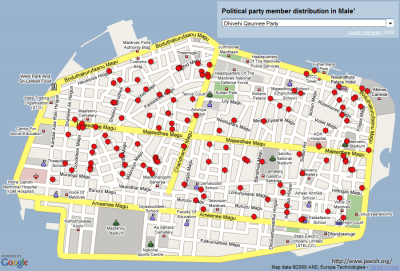
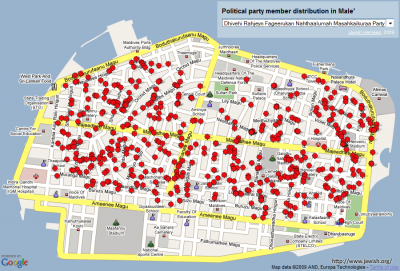
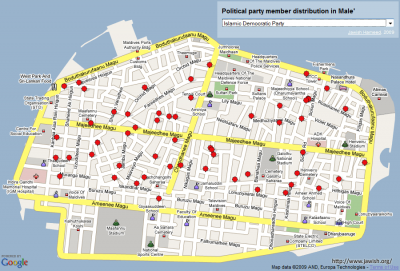
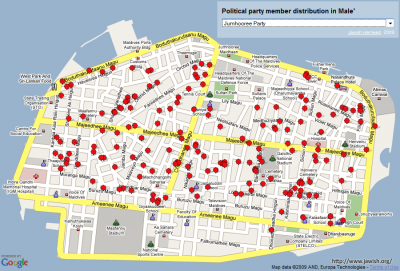
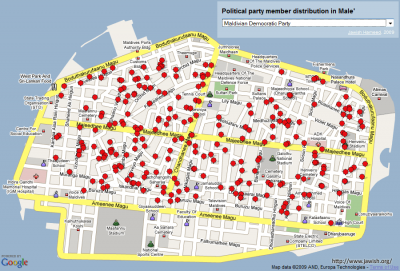
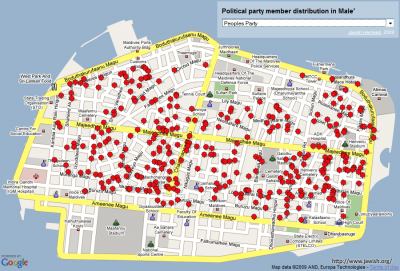
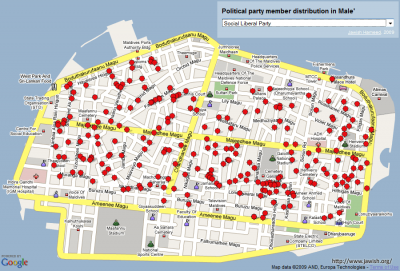
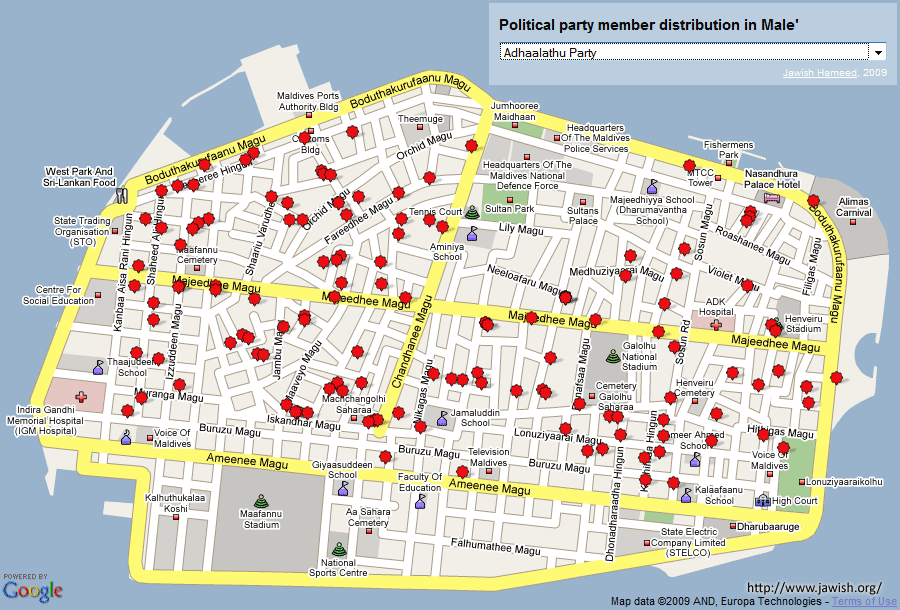
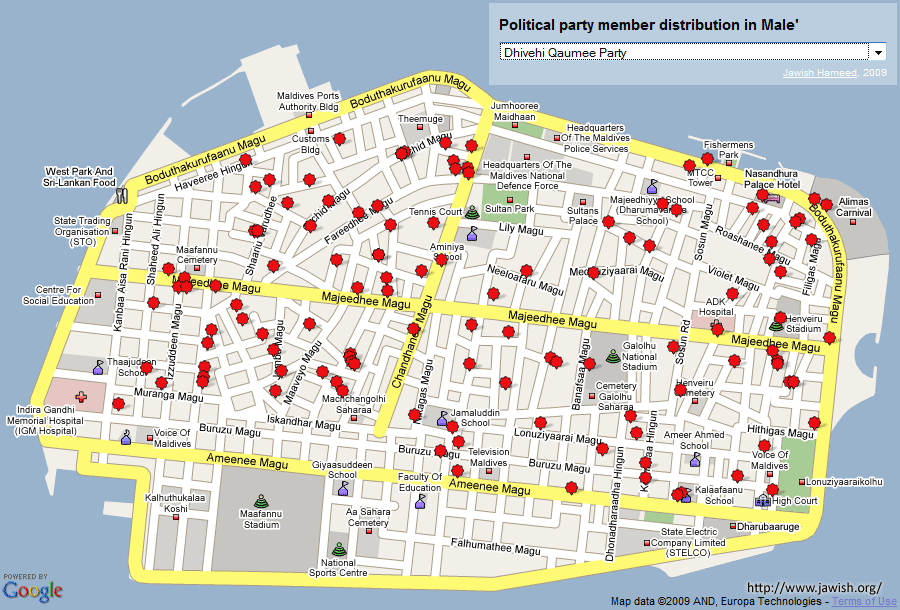
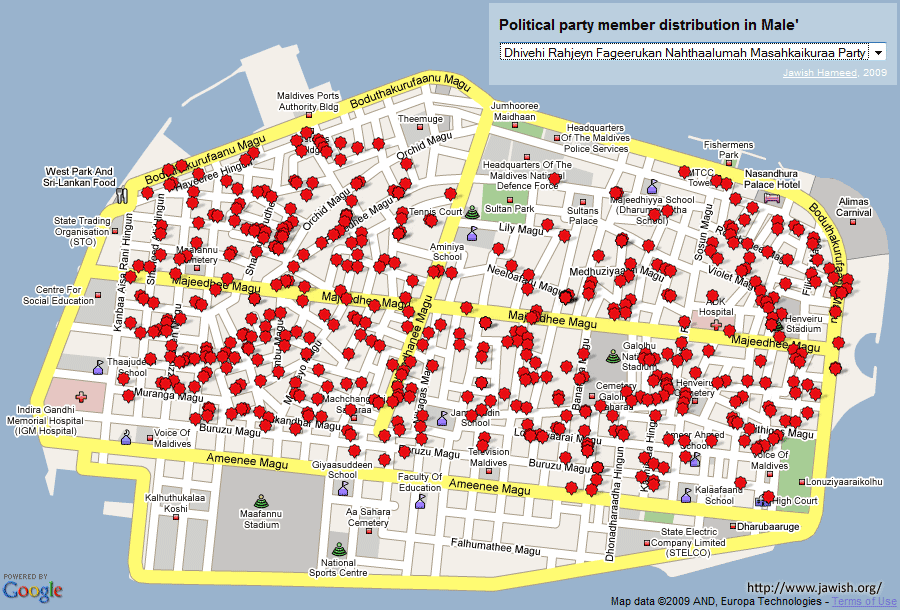
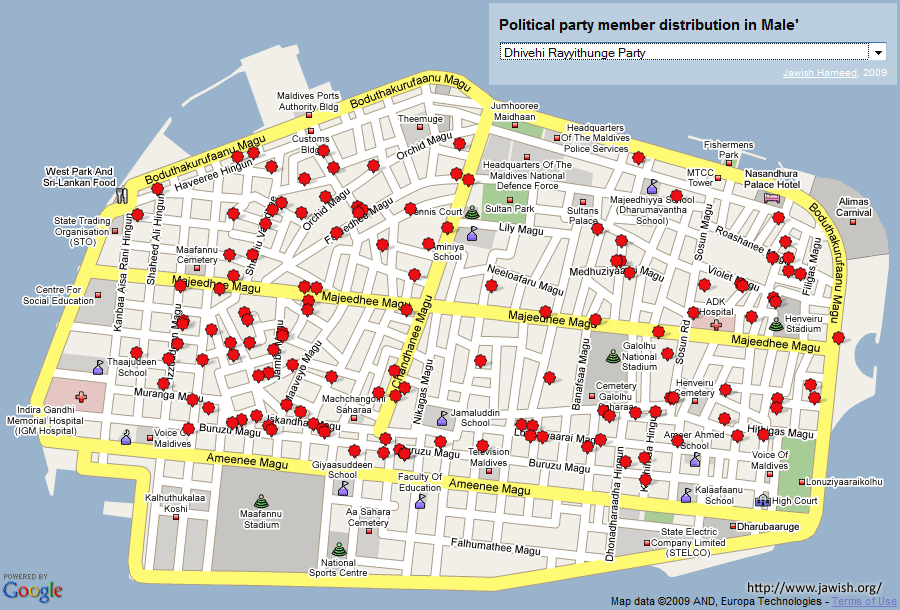
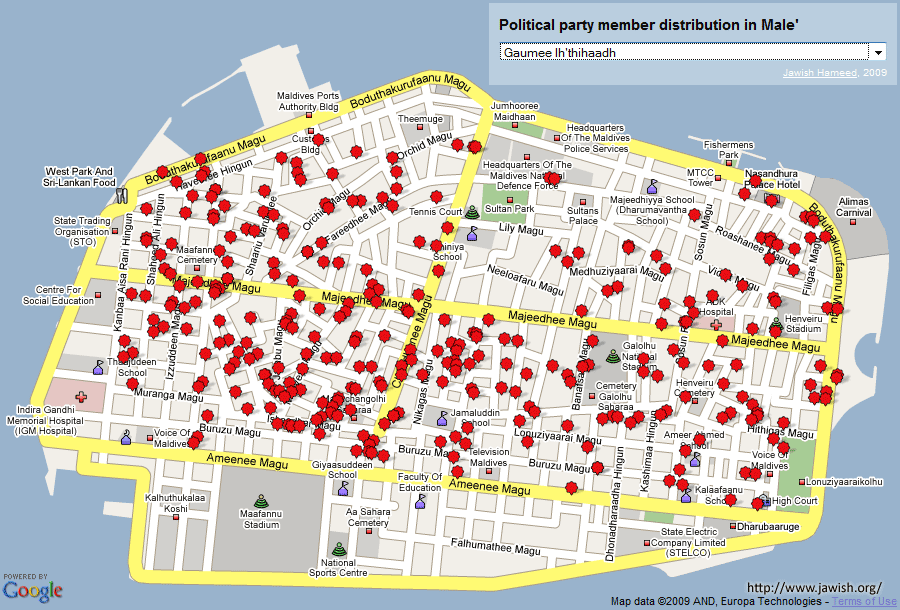
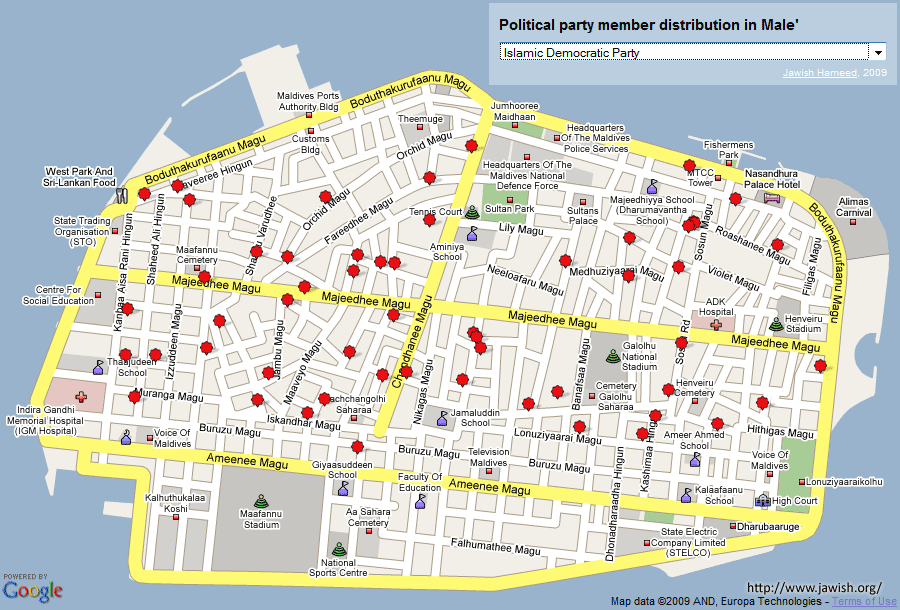
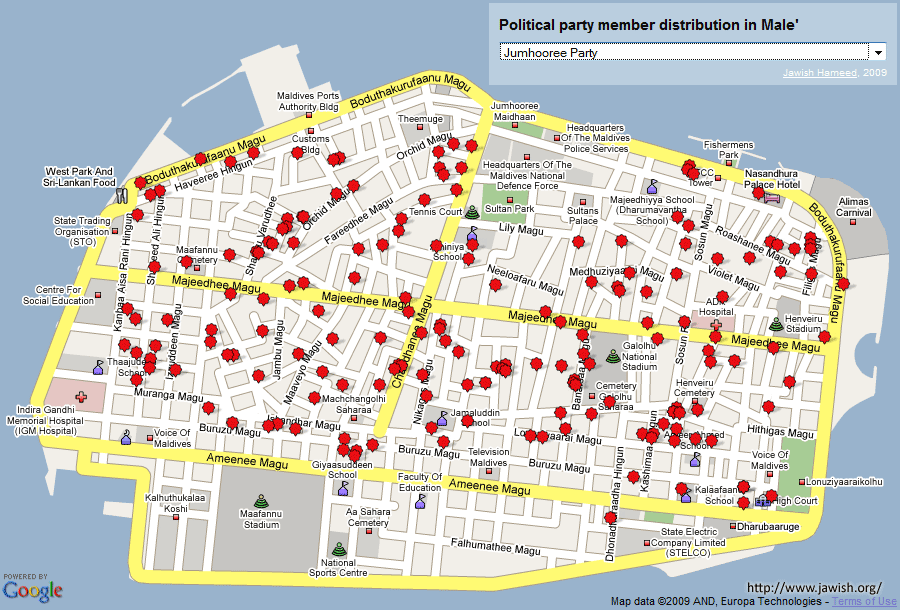
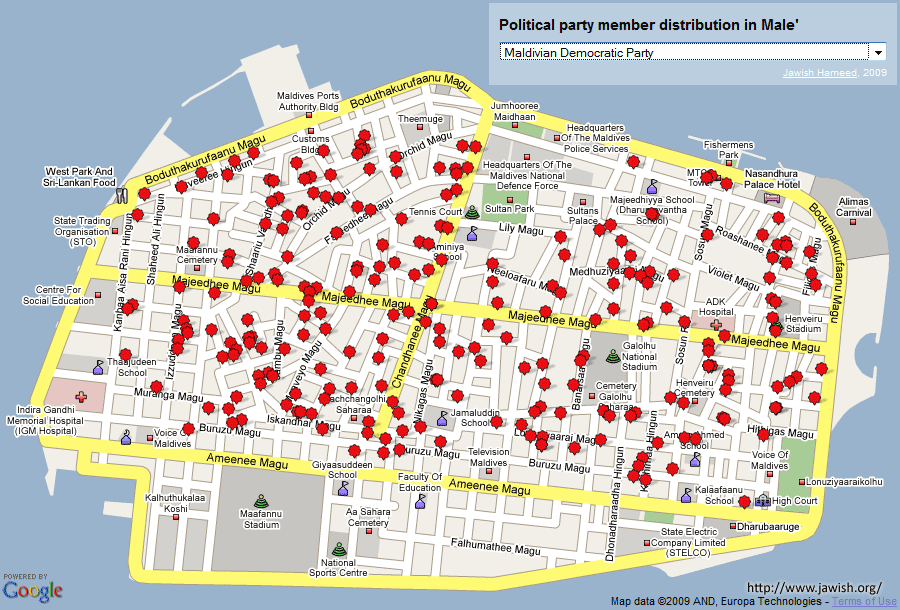
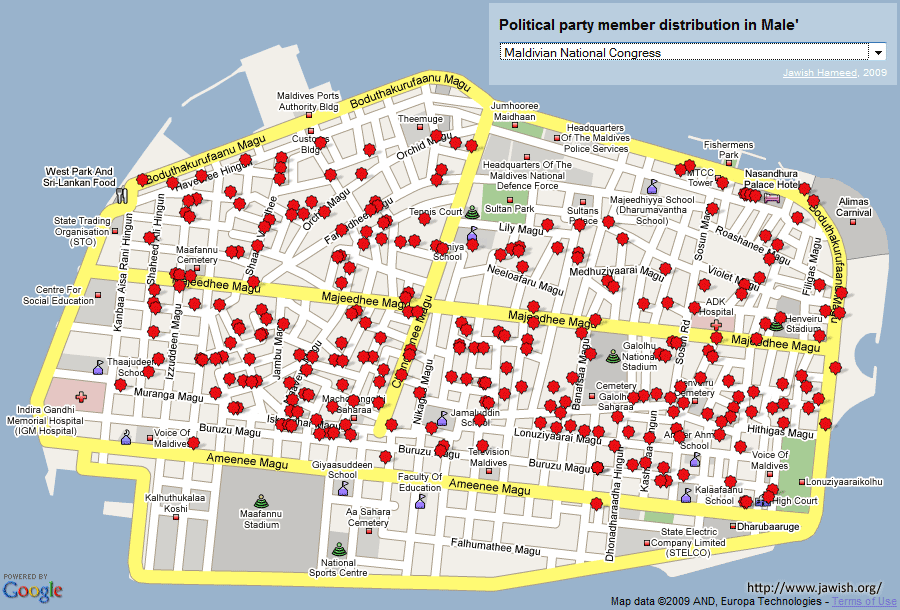
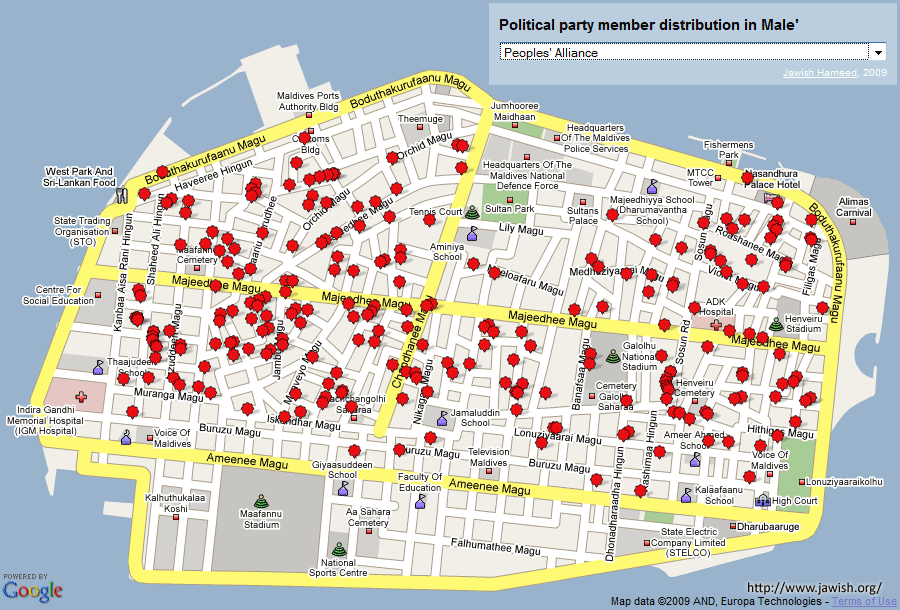
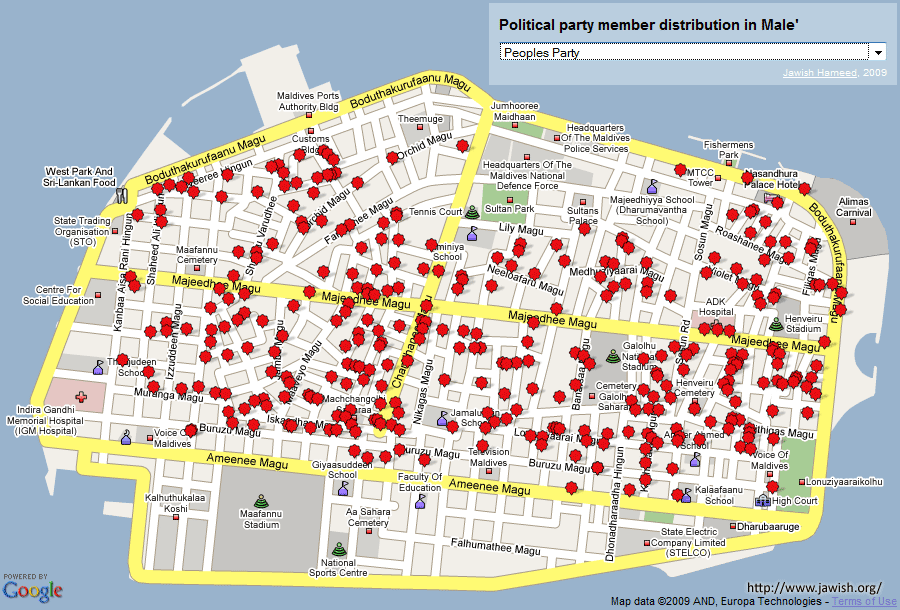
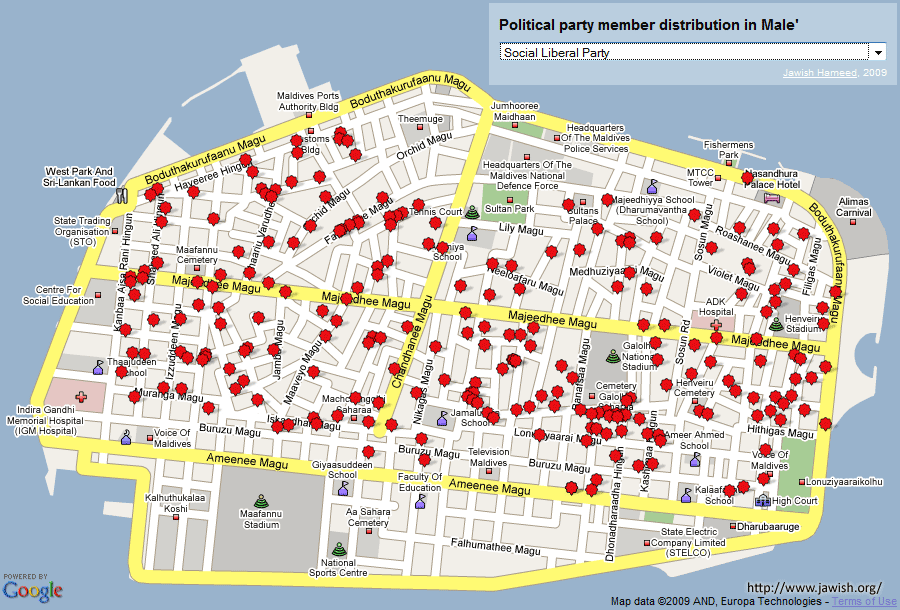
Here is a quick mashup I cooked up today, displaying the geographic distribution of political party membership on the map of Male' on Google Maps. To view the distribution for a party, open the link for the visualization, select the name of the political party from the drop-down menu at the top right. The addresses of members of that party will then be flagged with a little red marker. You will be able to zoom in-out, pan and do all those other things typically seen in Google Maps. Click a red marker to see more details about that address, like the number of people belonging to the selected party that are registered under that address.

The party membership information used for this is a snapshot of the data (taken 7 February 2009) published on the Members of Political Parties web portal by the Elections Commission. There were a total of 4,447 people belonging to 2,711 addresses in Male' listed in the Elections Commission data. Each party had membership numbers (given in brackets) in Male' as follows: Adhaalathu Party (175), Dhivehi Qaumee Party (261), Dhivehi Rahjeyn Fageerukan Nahthaalumah Masahkaikuraa Party (650), Dhivehi Rayyithunge Party (243), Gaumee Ih'thihaadh (592), Islamic Democratic Party (89), Jumhooree Party (246), Maldivian Democratic Party (507), Maldivian National Congress (386), Maldivian Social Democratic Party (25), Peoples Party (476), Peoples' Alliance (422) and Social Liberal Party (375). The maximum number of persons listed on a single address for a party was 12 and the average was 1 person per address (per party).

The geo-location information for the addresses was derived from the excellent services at Male-map.com and EAtolls.com. A total of 1,928 addresses were successfully mapped using these services, leaving a difference of 783 addresses which were then discarded. It is worth noting that of these addresses left out, 478 were just Dhaftharu numbers.

Please note that I neither claim nor guarantee the correctness or the completeness of any of the information used. That said, I did my best to ensure data integrity throughout the whole process of generating the visualizations.

- Click here to view the visualization
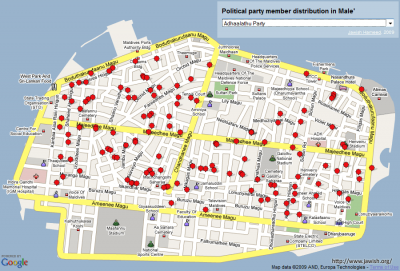
Adhaalathu Party
Snapshot: Adhaalathu Party

Dhivehi Qaumee Party
Snapshot: Dhivehi Qaumee Party

Dhivehi Rahjeyn Fageerukan Nahthaalumah Masahkaikuraa Party
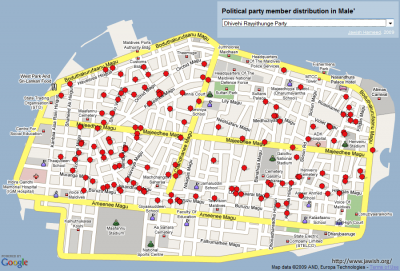
Snapshot: Dhivehi Rahjeyn Fageerukan
Nahthaalumah Masahkaikuraa Party

Dhivehi Rayyithunge Party
Snapshot: Dhivehi Rayyithunge Party
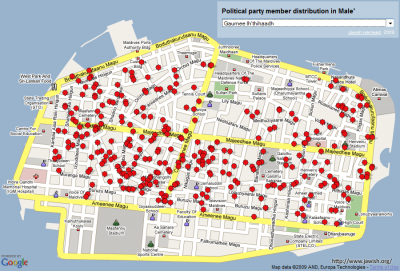
Gaumee Ih'thihaadh
Snapshot: Gaumee Ih'thihaadh

Islamic Democratic Party
Snapshot: Islamic Democratic Party

Jumhooree Party
Snapshot: Jumhooree Party

Maldivian Democratic Party
Snapshot: Maldivian Democratic Party
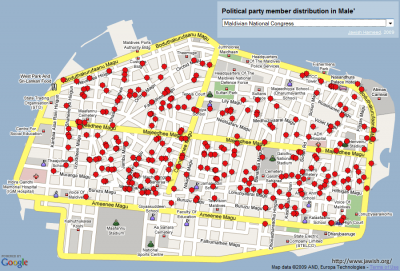
Maldivian National Congress
Snapshot: Maldivian National Congress
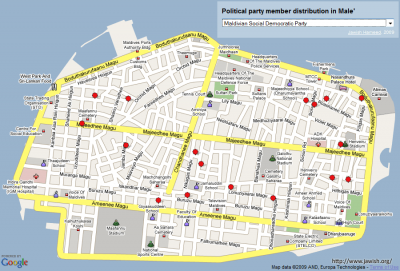
Maldivian Social Democratic Party
Snapshot: Maldivian Social Democratic Party
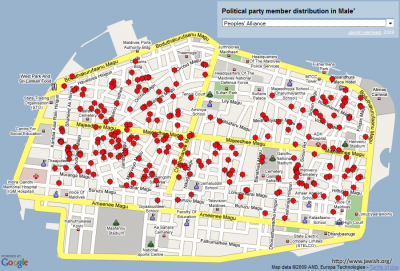
Peoples' Alliance
Snapshot: Peoples' Alliance

Peoples Party
Snapshot: Peoples Party

Social Liberal Party
Snapshot: Social Liberal Party
Phone usage (Maumoon, Political Parties, Government and Businesses)

I got curious today after reading Hilath's amusing post about an unsolicited SMS message he had received from a mobile phone number registered to DRP's presidential candidate Maumoon Abdul Gayoom. Now, this is a time of intense political competition between the various candidates camps and an originating number on a SMS is pretty easy to spoof, so I'm not sure if it really did originate from the said number (though with the desperation reeking from DRP it seems very likely that it did :-P). But that's not what really struck me...

What got my attention was the fact that there now was a publicly listed mobile phone number registered to Maumoon. I've never before seen a mobile number registered to him listed on the Dhiraagu e-Directory and a quick search through various old snapshots of e-Directory data that I had confirmed that there indeed had been none - atleast none up until early June which was the last e-Directory snapshot I had. Anyway, I grabbed a fresh snapshot of the e-Directory and spent a little while running some interesting queries on the data.

Here is some of what I found:

Numbers listed on e-Directory:
Mobile305198
Landline (Male')24423
Landline (Islands/Resorts)8750
Phones/Customer on Avg2.9


Political parties:
Dhivehi Rayyithunge Party92
Maldivian Democratic Party11
Social Liberal Party6
Adhaalath Party6
Islamic Democratic Party6
Jumhooree Party2
Peoples Party2


Registrants (Top 5):
Dhivehi Raajjeyge Gulhun Pvt. Ltd.833
Maldives Police Services200
State Electric Company Ltd.191
Indira Gandhi Memorial Hospital167
Maldives Customs Service164


Most common names (Top 5):
Mohamed Rasheed1273
Ibrahim Rasheed1250
Ahmed Rasheed1089
Ahmed Mohamed1088
Mohamed Ali1087


Government (Top 5):
Maldives Police Services200
Indira Gandhi Memorial Hospital167
Maldives Customs Service164
Min. of Defence & National Security141
President's Office139


Ministries (Top 5):
Min. of Defence & National Security141
Min. of Atolls Development114
Min. of Health76
Min. of Finance & Treasury76
Min. of Environment Energy and Water67


Businesses (Top 5):
Villa Shipping & Trading Co. Pvt. Ltd.163
Universal Entp. Pvt. Ltd.156
One And Only Reethirah149
One & Only Kanuhura125
Kurumba Village124


And finally...

Maumoon Abdul Gayoom
Mobile16
Landlines3


Note: The information presented was obtained using the entries on the Dhiraagu e-Directory (as available today).

Fingerprinting Thaana

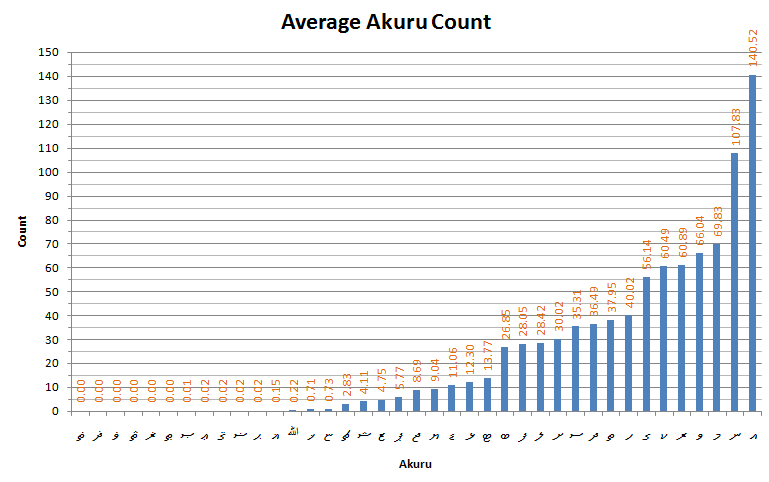
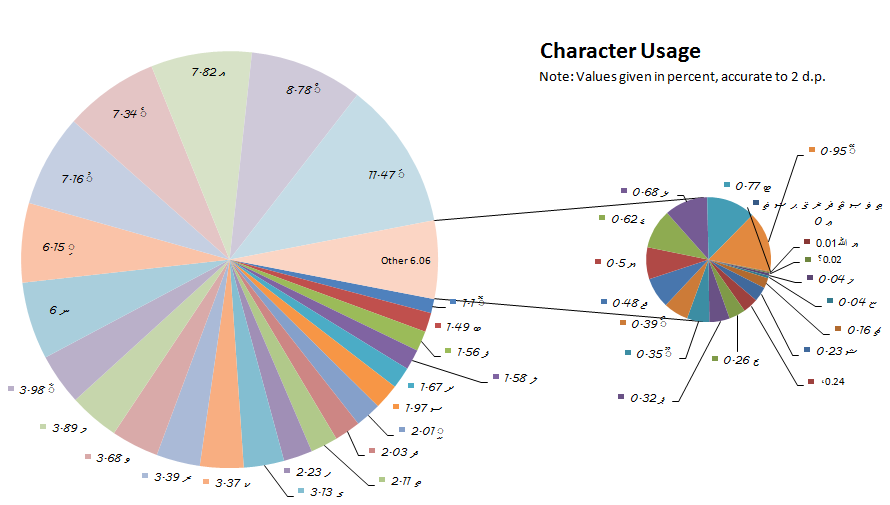
What is the frequency of characters in a typical Dhivehi writing? What is the most commonly used Thaana akuru/fili in Dhivehi? Is there a general pattern of akuru and fili to be expected in any given Dhivehi document?

These questions, and especially the latter, kindled my curiosity yesterday and had me off to explore a little bit. Although seemingly trivial and of no practical use, these are serious questions that probe into the finer details of Dhivehi and help produce computational models of Dhivehi - which have practical applications. Even the generalizations and patterns that result from the simplest statistical analysis transcend the (quirks of) individual writing and give a broader picture of what a language is really like. For example, I'm employing a statistical fingerprint of Dhivehi that was generated during this little exercise as part of an experimental procedure that identifies (the presence of Dhivehi) content in web pages. It takes advantage of the fact that the fingerprint for Dhivehi and that for English are dramatically different thus allowing a computer program to discern the type of content it is dealing with - all without really "understanding" a language.

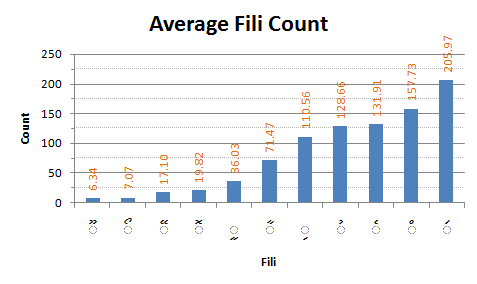
I conducted the analysis on a dataset consisting of ~5000 Dhivehi articles from Haveeru Daily and ~7000 Dhivehi articles from Jazeera Daily. They may not represent the whole varieties of Dhivehi literature available but I think they are a very good approximation - especially of Dhivehi web content which is what I was mostly interested in. My focus was on the individual character level and ran basic mean, mode, variance, standard deviation and frequency calculations with a further character correlation analysis. Despite these being quite simple analyses, I don't think anyone's ever explored as much before and hence the following should make for (exciting!) new information.

Enjoy :-)


Mean fili usage in Dhivehi writing


Mean akuru usage in Dhivehi writing


Thaana character frequencies